ASSERT
Auditing Implicit Assumptions in LLM-Based Coding Outputs
- Python
- LLM Agents
- Evaluation
- Software Engineering
Overview
LLM coding agents often resolve incomplete requests by choosing defaults, data formats, persistence mechanisms, error-handling rules, and interface behavior. ASSERT audits these implicit implementation assumptions after code generation, making the decisions easier for developers to inspect.
Given an underspecified prompt and its generated solution, the framework produces structured findings with assumption content, category, code evidence, and rationale.
Team: En-Chao Liu, Ava Zheer Wang, and Binyue Deng · Georgia Institute of Technology.
Research approach
We compared three monitoring strategies:
| Strategy | Approach |
|---|---|
| Inline self-reporting | The coding agent reports its assumptions while generating the solution. |
| External auditing | A separate model audits the complete prompt and generated output together. |
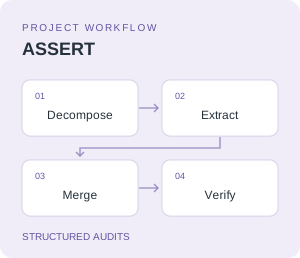
| Multi-agent monitoring | A four-stage pipeline decomposes the output, extracts assumptions, merges duplicates, and verifies findings. |
The multi-agent monitor includes prompt-overlap checks during extraction and verification to distinguish decisions made by the agent from requirements already stated by the user.
Benchmark & evaluation
The benchmark contains 22 coding tasks across five domains: backend APIs, frontend web, data processing, DevOps/infrastructure, and general coding. Two levels of prompt redaction produce 60 evaluation records: 38 with selected constraints removed and 22 reduced to a minimal high-level goal.
Evaluation separates two questions: whether an extracted assumption correctly describes an unstated code decision, and whether it recovers a predefined missing requirement or discovers an additional valid decision.
| Monitor | Precision | Targeted recall | Discoveries |
|---|---|---|---|
| Inline | 73.8% | 19.9% | 159 |
| External | 93.7% | 46.7% | 500 |
| Multi-agent | 79.2% | 44.0% | 481 |
Results from Table 2 of the final report. Targeted recall measures recovery of predefined golden assumptions; discoveries are valid assumptions outside that set. Evaluation used GPT-4.1 judges; human cross-validation remained future work.
Findings
- Full-context auditing performed best on this benchmark. Keeping the prompt and code together helped distinguish stated requirements from implicit choices.
- Decomposition introduced an alignment trade-off. Multi-agent monitoring extracted more assumptions per record, but its prompt-overlap rate was 17.1%, compared with 5.5% for the external auditor.
- Refining the multi-agent prompts improved discovery. Prompt-overlap checks and verifier changes reduced overlap from 20.3% to 17.1% and increased discoveries from 213 to 481 (+126%).
- Discovery matters alongside recall. Roughly 58% of correct findings were outside the predefined assumption sets, revealing design decisions the benchmark authors had not anticipated.
My contributions
- Designed frontend and backend prompt categories and contributed to task construction.
- Contributed to experimental pipeline planning and multi-agent monitor design.
- Collaborated on system architecture, experimental setup, monitor comparisons, and evaluation design.
The project shows why reliable coding-agent evaluation requires checking both generated behavior and its alignment with the user’s original instructions.